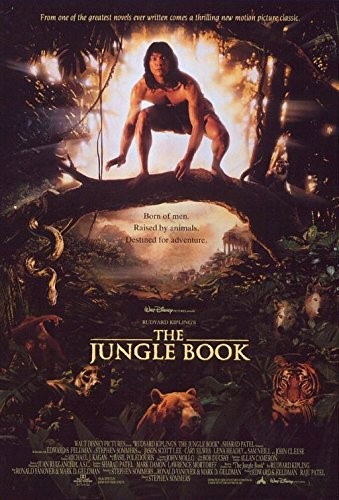
It was in 1894 that a collection of stories set in the jungles of India came about by author Rudyard Kipling. When rounded together, these stories are more commonly known as “The Jungle Book”, followed by a sequel series of books called "The Jungle Book 2". Over time, it’s been credited as classic literature, but its popularity remains largely through its many adaptions for film, and other media. For me personally, everything started with Disney’s live action 1994 film titled “Rudyard Kipling’s The Jungle Book”.

This was it, all my child hood fondness for “The Jungle Book” begins with this movie. As far back as I can remember, it shares a spot along with “The Wizard of Oz” as one of my very first live action movie experiences. Thus, it’s always remained a nostalgic benchmark as one of the very first times I embarked on an adventure in film, and well before I discovered any of the big titles like “Raiders of the Lost Arc”, and so forth. Just about every member of my family had that old VHS tape of the movie, and it just resonated with me as a classic. Truthfully, it wasn’t until years later, around the age of seven or eight, that I discovered the more famous animated Jungle Book movie by Disney. No joke, whenever someone mentioned Disney’s “The Jungle Book”, I always thought they were talking about the live action 90’s film. Even more embarrassing, I didn’t even know about Rudyard Kipling’s original books until I was well into my middle-school years. What really shocked me back then was that, despite Rudyard Kipling’s name being above the title, Disney’s 1994 live action version of “The Jungle Book” has very little in common with its source material. It makes this a tricky film to discuss, as it’s certainly not a faithful adaption of a classic source material, but regardless, I still have so much love for it as a memorable family adventure film from my child hood.


The movie opens with a memorable tracking shot on a map of India, mixed with a triumphant musical score composed by the great Basil Poledouris, who also composed the rousing score for 1982's "Conan the Barbarian". As our venture in the jungles of India begins, we meet Colonel Geoffrey Brydon, played by Sam Neill, who’s in command of a settlement, where a regiment of the British army is stationed. His little girl Kitty takes a liking to a small Indian boy named Mowgli, and leaves him with a bracelet from her late mother.

During a vicious attack from the tiger Shere Khan, Mowgli is separated from the group, and gets lost deep in the Jungle. There, he finds himself in the care of a pack of wolves, and a black panther named Bagheera. Years later, Mowgli grows into a man, but has lost all his humanity. Through a series of events, he finds himself reacquainted with the human world … and more specifically with his childhood friend Kitty, who’s now a grown woman. Recognizing her mother’s bracelet, Kitty identifies him as the lost boy Mowgli, and tires her best to re-educate him back to being a person. Unfortunately for Mowgli, the more he learns of the human world’s greedy and violent ways, the more he wants to return to being an animal. Into his midst comes a savage team of treasure seeking hunters lead by a British officer named Captain Boone, played by Cary Elwes. Using Kitty and her father as a bargaining chip, Boone forces Mowgli to lead his team on an expedition into the darkest parts of the Jungle, to find an ancient lost city … and more specifically it’s hidden treasure.

From that synapses, the film may sound less like an adaption of “The Jungle Book”, and more like “Tarzan” meets “Indiana Jones” ... but there are still some tie-in's with the source material. Most similarities with the novels are from Kipling's sequel series, which had tales revolving around Mowgli discovering a hidden treasure chamber guarded over by a snake (a cobra in the book, switched out to Kaa in the film), as well as a valuable dagger being the catalyst for a group of hunters to get killed off in the jungle, and even Mowgli growing-up and falling in love with woman are all elements cherry-picked for this films narrative.

However, another main source for this movie is the 1942 picture "Rudyard Kipling's Jungle Book", which likewise was a loose adaption of the books, focusing on Mowgli grown-up, and used by villains as a means to find lost ruins, with it's hidden treasure. As such, it's important to note that this 1994 movie didn't begin as a Disney production, and was bought by the studio in early development, allowing for the use of Disney exclusive characters like King Louie. So, even though it's labeled as the first of the live-action Disney remakes, it's better viewed as inspired by the early 1942 picture, but infused with elements and tones from the classic animated Disney film.


For me, this makes it fun to spot details lifted from the different sources. The treasure chamber in this 1994 film is a nice replica of the one seen in the 1942 picture, right down to the elephant statue in the center. I’m also a big fan of map paintings, as there’s such a timeless appeal to some of the map painted backdrops.

The ruins of “Monkey City” also provide some captivating designs and beautiful hand-built sets. As one of my very first adventure movies, this was the film that introduced me to conventions like explorers lighting a fuse that illuminates all the temple interiors and the treasure chamber. It’s something that would be replicated in future adventure films like “National Treasure” and “The Mummy”. On that note, this movie was directed by Stephen Sommers, the same talent who directed both “The Mummy” and its sequel. He’s a natural talent bringing energy, excitement and wonder to treasure hunting adventures of this sort. For example, I love when the temple is first illuminated, as there’s fire igniting from snake statues, and the flames light up various animal pictures, which are all paired with distinct animal sounds. It doesn’t make any logical sense, and is clearly the director being artsy, but it also enriches the setting with a unique atmosphere and mood. The jungle itself is a fleshed-out character with its own magical quality and personality. It’s a tight setting, but the locations and scenery are gorgeous to behold. The jungle itself feels alive with animals in every frame, and details like birds or monkeys in the foreground or background.

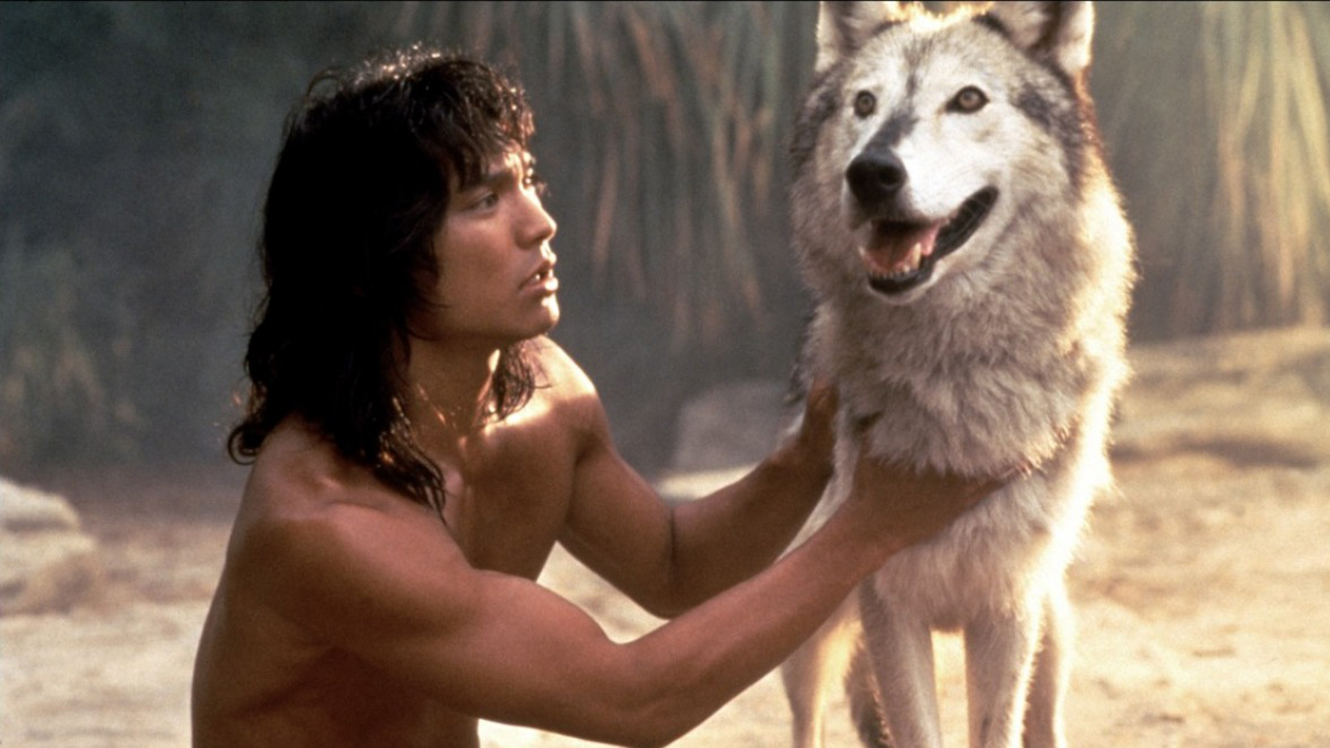
Another one of the films many strengths is the cast, which is comprised of many great talents that I was being introduced to for the first time through this movie. Jason Scott Lee is our star in the role of Mowgli, and it’s his commitment to the part that really drives the film.

It’s one of those special cases where an actor just disappears in the role, and everything he brings to the role feels like someone who was raised in the wild. His animal behavior, his curious expressions, his subtly developed human personality are all very genuine. The image of him running through the jungle with the wolf pack has always stood in my mind as something iconic. I also love the visual of him leaping off a huge cliff side, with a waterfall as a backdrop. Also, this movie introduced me to Sam Neil, and while it was through “Jurassic Park” that I became a fan of the actor, it was cool afterwards to connect him to a childhood favorite. In my view, Sam Neill was one of the decades most underrated great actors, and this movie highlights him at the prime of his carrier. Another one of my favorite actors who was in his prime was famed British comedian John Cleese in the role of Dr. Plumford. While this certainly wasn’t one of his funniest roles, his presence still adds a lot of charm and likability to the experience.


Next, let’s talk about Lena Headey as the love interest Kitty Brydon. Obviously, I’ve come to love and respect the actress over the years for her roles in “300”, and especially her portrayal of Cersei Lannister in “Game of Thrones”, but it was through “The Jungle Book” that I had my first crush on her. The image of her on the balcony of the India palace always made me feel like she was a live-action Disney Princess in a castle. While her character is a familiar archetype of both a damsel and a love interest, Lena Headey delivers a solid performance, and infuses the character with a mature, yet extremely lovable nature. She just radiates this sense of both joy, and beauty whenever she’s on screen, and her chemistry with Mowgli is very genuine. The scenes with the two dancing are also sweet, and as a side note, it was through this movie that I was introduced to the classic ballroom music of Johann Strauss, including “Wine, Woman and Song”, “Emperor Waltz”, and “Blue Danube”. I’m sure we’ve all heard his music in one form or another, and for me, I’ll always think of “The Jungle Book” whenever I hear one of his immortal tracks.


The last star who likewise makes this movie so appealing is Cary Elwes as the villain Capt. William Boone. While I’m sure most people remember the actor best for his roles in “The Princess Bride” or “Robin Hood: Men in Tights”, this is the role I’ve always associated him with the most. While Cary Elwes can definitely make for a charming hero, he also makes for a very charming bad guy.

It’s obviously a one-note bad guy who’s after both treasure and the attractive girl, but Cary Elwes carries the role with so much class, and delicious wickedness. Jason Flemyng is also very enjoyable as his boot licking partner Wilkins, who just doesn't know when to Shut-up. There’s also a second villain named Buldeo, who’s familiar with the ancient city our villains seek, and is also responsible for the death of Mowgli’s father at the claws of Shere Khan, during the opening attack. In Kipling’s stories, Buldeo was a hunter, and one of Mowgli's main foes, as well as the lead antagonist of the 1942 picture. This Buldeo is mainly an original character, who simply carries the name as a tribute. His enforcer is named Tabaqui, which is a nod to the golden Jackal Tabaqui, who served under Shere Khan in the books.


The cast continues to shine with all the animal’s featured in the film, and this once again adds to the appeal of the movie. Every single animal featured in this film is a professionally trained animal, and such a treat when compared to our modern movies, and all their CGI animals. The current live-action remakes of “The Lion King” and “The Jungle Book”, and their motion captured animals, while technically impressive, just don’t hold a candle to what this film accomplished back in 1994.


Without a doubt, the animal with the most commanding presence of all is the Bengal Tiger named Shere Khan. Ever sense my childhood exposure to this movie, Tigers have been my all-time favorite jungle animal. Unlike most versions of “The Jungle Book”, Shere Khan isn’t a villain in this film, and instead is a neutral force of nature. He’s basically the jungles watchful guardian, and the keeper of the jungle laws. While Shere Khan dose kill Mowgli’s father in the opening, the two never become rivals, and only have one encounter at the very end of the movie. Shere Khan challenges him to see if he’s more man or animal, and in the end, Khan respects Mowgli as a creature of the jungle. While I’ve always loved the concept behind Shere Khan’s new formed respect for Mowgli, the initial stair down between the two is admittedly kind of goofy in its execution. Regardless, this is still my favorite portrayal of Shere Khan, as he brings a great deal of tension to the film without becoming a villain in the process.


My absolute favorite individual scene is another one of the more serious and frightening moments, in which Captain Boone takes Mowgli on a tur though his section of the palace. The conversation starts off calm and well mannered, but things gradually get more heated as Mowgli discovers what kind of sick and malevolent man the Captain really is. He then turns left into Boone’s office, which is full of taxidermy animals.

This triggers a mental vision in Mowgli, as he hears the gunshots and horrific animal cries coming from the lifeless creatures surrounding him. This scene was shot with a great deal of intensity, tight edits, and a relentlessly haunting overtone. The scene would later be spoofed by Jim Carry in the comedy “Ace Ventura: When Nature Calls”. Another emotional highlight is when the bear Balue makes a noble sacrifice, and takes several bullets in order to protect Mowgli. This scene was always hard to watch as a kid, but I love the way it was shot, especially when Mowgli goes running off in grief, and the color pallet turns Black and White. Now, I will admit that for every dramatic highlight, there’s also something really cartoony that doesn’t seem to fit with the tone of the film. One little off-putting detail takes place during a chase scene, in which a man snake charms a rope to become a ladder, and subsequently providing our hero a convenient means of escape. Thankfully there aren’t too many moments like that, but when they happen, it tends to break the mood.


Once we get to the third act, this PG Disney family film takes quiet the dark turn as every one of the villains is killed off in memorable and horrific way.

Boon is eaten by Kaa, poor dumb Wilkins gets shredded by Shere Khan, Tabaqui falls off a cliff side, and the death of the villain Buldeo is like something from out of a “SAW” movie. As he’s chasing Mowgli through the temple, he gets sealed in a small room that slowly fills with salt. That terrified me as a kid, knowing that he was in for a slow death, and with absolutely no chance of escaping the sealed-up room. The most terrifying death of all was the cruel jailer, who after giving Mowgli all kinds of abuse, meets his demise by sinking in quicksand.

It’s another slow burning death scene as just sinks into the disgusting black muck. I really don’t know if I should write the violence and darker moments off as a positive or a negative. It’s not material I’d typically want to show kids, but at the same time, the film leaves a lasting impression on us young viewers. It also makes the movie all the more fun to look back on and say “wow, can you believe we were exposed to this as kids, and from Disney … it’s kind of amazing”. Personally, I never felt that the dark or violent moments went too far, as I remember watching this and pulling though it fine. While the film is paced well, and genuinely exciting, the one thing that unfortunately doesn’t hold-up are the fight sequences. The film has great set-up, but clumsy choreography, and awkward staging ... which is shocking for a movie with a martial arts legend like Jason Scott Lee in the staring role. For example, there’s a scene in which Mowgli fights Tabaqui, and it's so awkwardly staged, it looks like two people trying to hug each other to death. The final show-down between Mowgli and Boon is another perfect example of great fighting potential that comes off as average, and even goofy in execution.


So, in the end, dose Disney’s very first live-action remake of “The Jungle Book” really hold up? Well, it certainly does for me, but that’s also a very personal opinion brought on by my childhood nostalgia of growing-up with it.

I know it doesn’t work as a faithful adaption of a great literary source material, but then again, several other note-worth movies have strayed from their respected books, and turned out classics in their own right. Look at both “The Shining” and “The Wizard of Oz” as perfect examples, as neither are judged as faithful adaptions, and are more commonly viewed as just great movies in their own right. For me, 1994’s “The Jungle Book” is no definitive version, but it is my personal favorite, and the one I look back on with the most fondness. It has just enough of an edge to appeal to adults, but just enough warmth, charm and excitement to appeal to kids. I also feel that with all the different versions of “The Jungle Book”, this film offers a refreshing and unique alternative. While the movie obviously has its cheesy moments, and dated qualities, the majority of it still wins me over. I love seeing real animals performing on film, I adore the cast, the scenery is gorgeous, and I always feel submersed in the films rich jungle setting. More to the point, I feel this film works as a good bridge for kids to transition from kid friendly fun to more adult adventures. I loved this movie back when I was a child, I still love it just as much as an adult. It’s certainly not for everyone, but I hope more people re-discover it over time.

Thanks for reading my review of Disney’s 1994 adventure film “The Jungle Book” ... and continue to enjoy the movies you Love!


