

It may seem like a minor thing to highlight, but I absolutely love opening credit sequences in movies. This is the moment when a movie can suck you into what kind of world, personality, tone or environment the film has to offer, and when done right, they can effectively establish my feelings on a film before it even gets started. I love it when there’s something creative, something animated, something musically engaging, or just something very atmospheric to go along with the opening credits, which can get me so hyped up for a film.

In recent
years, opening credits have appeared less frequently in movies, much to my
disappointment. However, there are still two reliable sources that always deliver
with their opening titles, one of them being the James Bond franchise, and the other
being any kind of movie directed by Tim Burton. He always seems to relish the
art of building-up the movie experience, and utilizing his opening credits in
very distinct ways. As such, I thought it would be fun to stop and rank all 21
opening credit sequences from the openings of his directed movies (including “The
Nightmare Before Christmas”, which I know he didn’t direct), on my own personal
scale from least favorite to absolute favorite.
#21 The opening credits to “Pee-Wee’s Big Adventure” (1985)

This marked Tim
Burton’s very first theatrically directed movie, and for me, it was his weakest
opening credit sequence, as both the title and ensuing credits are presented
against a flat, black backdrop. Aside from the crayon colored title, there’s
very little to look at to get me excited … but the one saving grace is Danny
Elfmans accompanying music score, which at least helps set the playful mood of
the film. Elfman’s music will be a reoccurring highlight in the majority of Tim
Burton’s films, and by extent, his opening credit sequences.
#20 The opening credits to “Big Eyes” (2014)

In this Tim Burton directed Biopic, we get an opening title sequence that looks like the lead into a documentary, right down to the very basic text credits on display. The credits themselves don’t last long, but it suitably leads into a nice title card, matched with a somber, yet soothing theme song.
#19 The opening credits to “The Nightmare Before Christmas” (1993)

While this
movie features one of my favorite opening musical numbers, it really can’t be
counted as part of an opening credit sequence. In fact, there’s little more
than the title card, once again presented against a black backdrop, accompanied
with suitably moody music. It works okay, but it’s still only a foot note
compared to the actual opening credits that are still to come.
#18 The opening credits to “Dumbo” (2019)


Perhaps the most usual entry on
this countdown, as it’s an opening credit sequences … without any credits displayed.
We have a nice little opening montage of the traveling circus train, complete
with cartoony transitions and edits, and even a pleasant rendition of the
classic animated Disney movie score, but for some reason, only the studio
credit and title card are displayed during this whole sequences, which is clearly
meant for the credits.
#17 The opening credits to “Dark Shadows” (2012)

Once again, we have an opening montage set on a train, but this time with the credits properly presented. We follow a girl as she travels to the films central spooky house, which is a basic, yet practical use for an opening credit sequence. The one big difference to note is that it’s not matched to a Danny Elfman score, and instead is matched with a pop-song, 1967’s “Nights in White Satin”, performed by The Moody Blues. It’s an odd choice, but it gives this opening a different feel from any other Tim Burton movie.
#16 The opening credits to “Alice in Wonderland”

Here’s yet another opening
that’s a title card only, and no real opening credits, but with that said …
this is a terrific opening title card. The way it appears through smoke stakes,
fills the whole screen, and matched to Danny Elfmans catchy chant … it gets me
hooked. Personally, this is my least favorite of Tim Burtons directed movies, but
this title card gets me excited like it’s one of my favorites.
#15 The opening credits to “FrankenWenie” (2012)

For one of Burton’s more
gentle and relaxed family films, we get an opening credit sequence that
appropriately compliments the tone moving forward. It’s as simple as they get,
as we see the daily activities of our lead boy with his dog, and it’s all very
nice. The Dany Elfman score sounds derivative of his earlier work, but it’s
okay, and this opening title sequence is fine for what it needs to be.
#14 The opening credits to “Beetlejuice, Beetlejuice” (2024)

In a loving nod
to the original “Beetlejuice”, we get an opening credit sequence that’s
an overhead shot of the town, this time it’s not the model, and there’s edits
giving us different angles. Danny Elfmans score is likewise that same as the
first, just with more bells and whistles added in. Personally, I would have
preferred an original opening credit sequence, but this was still a nice
tribute to the first, and got me excited for this long-delayed sequel.
#13 The opening credits to “Corpse Bride” (2005)

Just like with the previously mentioned stop-motion animated picture “FrankenWenie”, this opening title sequences is short, simple, and gets the job done with very little on display. We get our first glimpse of our main character, and it sets the personality of the London setting as being more lifeless than the afterlife setting that will appear later. Dany Elfmans score this time around isn’t big or bombastic, nor is it overly moody, it’s just the right marriage of blissful, but with a pinch of melancholy.
#12 The opening Credits to “Miss Peregrine’s Home for Peculiar Children” (2016)

Now we
come to the more traditionally stylish and fun of Tim Burton's opening credit
sequences. For this lead in, our opening credits are presented with a montage
of photos, newspaper clippings, sightings on maps, and all done in this unique photo
inverted effect. The musical score is ominously building in tempo, while
matched to the sound of a ticking clock or metronome, and it’s all very
exciting.
#11 The opening credits to “Big Fish” (2003)

Perhaps the longest of Burtons opening credit sequences, as it’s
spread throughout the opening five minutes of the film, in which we’re
introduced to our main characters. Also, while Dany Elfmans whimsical score is
present, most of the tone is set through narration by Ewan McGregor’s lead
character. The imagery on display is peaceful, and this whole lead-in is very
comforting, like we’re about to see a modern fairytale come to life.
#10 The opening credits to “Batman Returns” (1992)

This opening credit
sequence follows a baby carriage floating through Gotham’s elaborately designed
underground sewer channels. The Batman franchise is another one with great
opening title sequences, and while this isn’t one of the absolute best, it’s
still something to savor as it’s the last time we’ll get a title opening
matched to Danny Elfman’s iconic Batman score.
#9 The opening credits to “Sweeney Todd: The Demon Barber of Fleet Street” (2007)

Without question, this is the darkest of Tim Burton's movies, and
naturally, its opening title sequence is arguably the most ominous and
unsettling of the whole collection. This time we’re given an animated visuals
montage that foreshadows the bloody and horrific events of the film.
Complementing the Gothic imagery is a score comprised of deep organs, and it
absolutely sets me on edge. It’s an effective title sequence to set the mood of
the film … and it promises to be dark.
#8 The opening credits to “Charlie and the Chocolate Factory” (2005)
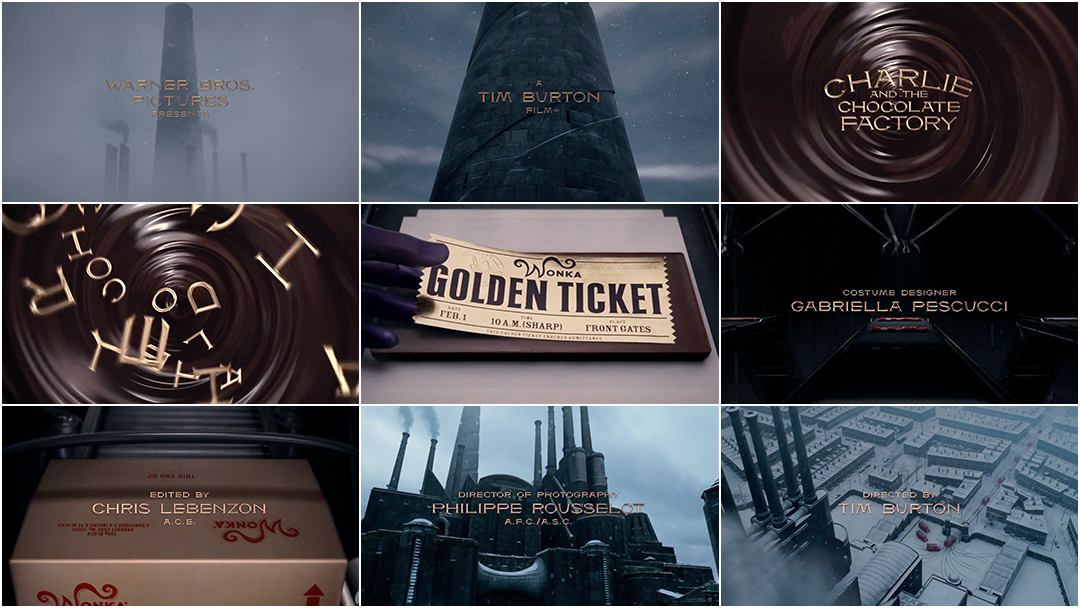
While
this second adaption of Roald Dahl’s book has always been one of my lesser favorites
of Tim Burton’s offerings … I will admit that the opening credit sequence is
wonderful. The titles this time around are set to a montage within the
chocolate factory, which looks like a technical marvel, but still with elements
of fantasy and enchantment on display, like parashooting chocolates and so
forth. Danny Elfmans score this time around is also very distinct, and couldn’t
be confused with anyone of his other Burton collaboration scores.
#7 The opening credits to “Beetlejuice” (1988)


After a striking title card,
we’re presented with a single tracking shot over a model city, which is a
fairly standard presentation for an opening credit sequence. However, what puts
this above all the previous films naturally is Danny Elfmans wild and bombastic
score. It conveys so much personality and fun, that it sets the mood without
the need of a big visual presentation.
#6 The opening credits to “Planet of the Apes” (2001)


This outing begins with
an awesome opening credit sequence, with a foreboding overtone, eerier music,
and lots of cool imagery. While Tim Burton’s remake of the classic “Planet
of the Apes” was unnecessary, I just can’t dismiss how much I love this title
sequence. Danny Elfmans music score is emphasized with low, moody percussion
instruments, similar to the original Jerry Goldsmith score, but with a synthesizer
beat that builds to a satisfying final image, with a pair of eyes looking at
the camera … it’s great.
#5 The opening credits to “Sleepy Hollow” (1999)


This is personally one of my
favorites of Tim Burton’s movies, and Danny Elfmans score once again is
outstanding. This time around, for our opening titles, the movie goes for the
subtle abroach, as we follow Ichabod Crane on his coach ride to the titular
Sleepy Hollow. The deep scenic views of the forest setting, all-encompassing
wide-shots, and striking imagery, laced with Danny Elfmans foreboding music
cues hook me in every time I watch this. This title sequence once again
highlights how the little things can go a long way, and an elaborately designed
visual montage isn’t always required.
#4 The opening credits to “Mars Attacks” (1996)

As the title would suggest,
this movie is about aliens from Mars attacking Earth, and to really hit the
point home, the whole opening sequence is watching a fleet of flying saucers
leaving their base, and heading to our beautiful blue planet. The effects on
display are a fine mix of cheesy and appealing, and in a creative touch, the
credits themselves spin like ships. I know I sound like a broken record, but
it's Danny Elfmans score that makes this one of the best lead-in’s to any of
Tim Burton’s movies, as it conveys a sense of both goofiness and dread for the
approaching Martians.
#3 The opening credits to “Ed Wood” (1994)

While Burton commonly takes an artistic approach to his openings, this one stands out with a distinct charm and personality. Real life director Ed Wood made some of the cheapest horror movies of all time, and the opening title sequence to Tim Burton’s 1994 biopic titled “Ed Wood” is very crafty in celebrating his films in every possible way. We begin with a creepy house in the middle of a stormy night, there’s lots of lightning, the cast names are carved in cheap looking gravestones, we get a stop motion octopus, flying saucers, and some excellent background music. The score this time around was composed by Howard Shore, and it’s a loving nod to 1950’s B-list Sci-Fi pictures. It’s a great intro, and without question is one of Tim Burton’s best opening credit sequences.
#2 The opening credits to “Batman” (1989)


Not only one of Tim Burton’s best opening
title sequences, but one of the best of the whole Batman film series. The
camera travels through a lot of dark tunnels, the music builds and then in a
big pullback shot it’s revealed to be the Batman logo. It gives me chills every
time, and the classic score by Danny Elfman is one of the greatest music themes
ever composed for a superhero movie. It fits the character perfectly, and it’s
one of Elfman’s greatest achievements.
#1 The opening credits to “Edward Scissorhands” (1990)

At last, we come to my favorite of all Tim Burton’s opening credit sequences. The look and feel is dripping with Burton’s signature gothic atmosphere, but also punctuated with this whimsical and enchanting personality. The imagery on display is so elaborate, with odd shapes and figures in this crazy castle, laboratory interiors, and framed in these cold colors. It’s all mixed with Danny Elfmans unforgettable score which is just so haunting and beautiful … I’d say it’s my favorite of all his movie scores. This is the opening that really draws me into this crazy yet brilliantly crafted world from Tim Burton, and it leaves me with goosebumps every time.

Thanks for
reading my countdown … and continue to enjoy the movies you Love!


