Tuesday, October 30, 2012

Creepshow (1982) (Movie Review)


   The horror movie genera is one that mostly takes itself seriously, but once and a while comes something unique that goes for both fun and creativity. The 1982 motion picture titled “Creepshow” is perhaps as unique as horror movies get, with a style, presentation and personality unlike any other. 
It’s a theatrical anthology of five spooky short stories combined into one film, but unlike other horror anthologies, this film also fits right in with our modern-day comic-book genera. While it doesn’t have a direct source, the majority of the film takes inspiration from many of the classic 1950’s DC and EC comics like “House of Mystery” and “Tales from the Crypt”. As such, "Creepshow" captures the look and style of a comic book, with graphic panels, colorful visuals that pop on screen, comic-book strip transitions, word boxes and animated segues appearing all throughout the film. While many resent superhero movies have emulated similar aesthetics and tones, it was “Creepshow” that got the ball rolling, and can even be sighted as something ahead of it’s time. As such, it’s one of those rare movies that has no limit to how wild, fun, inventive, frightening or disgusting it can get. Horror Anthology’s in general are always exciting, as you never know what you’ll get next, but this is the one bound by no rules, and anything can happen.


  One of the films greatest achievements was bringing together some of the Horror genera’s greatest pioneers together for one project. The first is director George A. Romero, who’s often cited as the great Godfather of the horror genera, as he created two of the most influential Zombie classics “Night of the Living Dead” and “Dawn of the Dead”. The second is famed Author Stephen King, who’s resume consists of such thrilling titles like “Carrie”, “The Stand”, “Firestarter”, “Cujo” and “Salem’s Lot” … just to name a phew. Not only did Stephen King write the screenplay, but two of the episodes are adapted from his short stories. In essence, George A. Romero paired with Stephen King is just as exciting as merging Frankenstein with Dracula. The last talent to note is Tom Savini, who’s special effects, and makeup designs have become staples in horror cinema. As you’d expect, he’s the visionary behind the creature designs of the film, but he also contributes to the overall comic book presentation and style of “Creepshow”.  


  It’s probably best to single out the individual shorts, and review them one at a time. The first episode is titled “Father’s Day”, which revolves around a grumpy old man who comes back from the dead as a zombie to seek revenge on his greedy family members. This is easily my least favorite episode of the bunch, as it’s about as basic a premise as they get with no real twists or excitement. One thing to take note of is Viveca Lindfors straight-faced performance as the bitter Aunt Bedelia. I’ll also give credit to the make-up design of the Zombie, which is one of the most original and grotesque I’ve ever seen. Still, this is a weaker episode, doesn’t leave much of an impression, and features some really odd moments ... like a Zombie using “The Force” to drop a tombstone on one of his victims.


  Next is “The Lonesome Death of Jordy Verrill”, which is easily the goofiest short of them all. A meteor crashes on a farm and spreads some kind of plant vegetation across the land, and slowly transforms a farmer into foliage. It’s kind of a neat premise to have something as simple as plant growth be the main situation at hand. The real reason this episode stands out is because of Stephen King’s over the top performance as the farmer. It’s a fun contrast to see the guy who scared people with countless frightening stories to be this goofy dope of a farmer. Once again, I wouldn’t exactly call this a great short, but it’s certainly superior to the first, as it’s at least more memorable.


  The middle short is titled “Something to Tide you Over”, and straight to the point … this is my favorite episode of this whole anthology. It’s a far more serious and grounded tale revolving around a vengeful husband, who lays out a nefarious plan to do-in both his wife and her new lover. The appeal of this short is due to the villainess lead performance from one of my favorite late actors Leslie Nielson. I’ve been a fan of Nielsen for years, namely his iconic comedy roles in films like “Airplane” and “The Naked Gun” trilogy. Seeing him out of his wheel house, and in the role of a vengeful mastermind is quite admirable, and his performance highlights just how versatile he was as an actor. The way he calmly talks to his victims, and taunts them as they suffer is very unsettling, yet it’s a highly entertaining delivery. The culmination of his revenge is an unbearably suspenseful sequence in which both his wife and her new boyfriend are buried neck deep on the beach as the tide comes in. Another noteworthy talent in this episode is the boyfriend, who's played well by Ted Danson of "Cheers" fame. The story does get over the top near the end with more gruesome creatures, and a spooky haunted house atmosphere, but for the most part, this is the most subdued, well-paced and most genuinely suspenseful short of the whole feature.


  Episode four is titled “The Crate”, which is a duel story revolving around a husband who’s suffering at the mercy of a cranky wife, as well as a mysterious box that contains a savage monster. This is another solid short, with some electrifying buildup, exciting creature action, and some genuinely effective scares. Perhaps the most startling moment of the whole film is our first glimpse of the creature, which is nothing more than two piercing yellow eyes glaring through the holes of the crate. The creature looks like a hybrid between Bigfoot, and a Tasmanian Devil, which is great. It’s the longest of all the episodes, but it’s well plotted and delivers cheesy, B monster entertainment at its finest.


  The last episode titled “They’re Creeping up on You”, revolves around a cruel manager, who’s also a germaphobe, and is constantly being attacked by bugs in his clean room. This short goes straight for the gross out factor, and it doesn’t shy away from some unforgettably shocking visuals. “Bravo” even labeled it as one of the one-hundred scariest moments in film because of just how repulsive it gets. If you can’t handle the image of cockroaches bursting out of a man’s body, you should probably skip this one. While not my absolute favorite episode, it is the most effective to close out the movie, and the nasty imagery in this short leaves the most effective sting on the audience.


  Now, I have to mention both the prologue and the epilogue, which in my view is the absolute worst aspect of the film. Things are at least off to a good start, as it’s a rainy October night with house-hold Halloween decorations taking up the scenery. We see an abusive father frustrated with his son for reading the actual Creepshow comic book, which effectively foreshadows certain events, and sets the tone of the movie quiet well. My one issue with this whole thing is the little boy, who is clearly disturbed and twisted from the start. Maybe if this kid was just a misunderstood innocent, I’d be okay, but he’s clearly evil from the start, and the dad was right to scold him for it. We return to this family during the epilogue, and this right here is the moment that ruins the entire experience for me. While dark comedy had been laced through the film, this boy’s methods of getting revenge on his dad are down right sick, and disturbed. Basically, he kills his own dad, which is terrible, but it’s his means of doing-in his dad that really kills all my positive feels for this movie. I mean, I still like this movie overall, but it would absolutely rank higher among my favorite horror films if it weren’t for this awful and tasteless ending.


Creepshow 2 (1987)

    Without going into a full-on review, I want to lightly talk about the 1987 sequel simply titled “Creepshow 2”. George Romero, Tom Savini and Stephen King are all back for this film, giving it that same fun comic book, anthology style, and adapting more of Stephen king’s short stories. 
However, the style is noticeably downgraded from before, and it lacks that same colorful presentation that characterized its predecessor. The real down side is that this movie only features three shorts, which robs the film of the fun variety present in the first film. These shorts now have to be stretched out to relentlessly long lengths, and they overstay their welcome in the process. This especially applies to the first short titled “Old Chief Wood'n head”, which wasn’t even that interesting to begin with. Basically, a group of bullies pick on an old store owner, and then a statue from the shop comes to life to take revenge of those bad kids. It’s so simple, yet it takes up too much of the film. The middle short titled “The Raft” suffers from annoying characters, but makes up for it with an original and suspenseful premise. A group of teens get stuck on a raft in the lake, with a mysteries substance underneath that can melt flesh. It’s a unique situation, with some effective tension, and it could have almost worked had the characters been more likable. To finally pore salt on the wound, we have the final short titled “The Hitch-hiker”, and this right here is my absolute favorite of any Creepshow short. This episode revolves around a woman who’s coming home late one-night after work, gets lost, and accidentally runs into this pore man on the road … taking his life. In the heat of panic, she drives off, and gets even more lost in the woods. 
She’s having a hard time copping with what just happened, and things get even more intense as she finds herself followed by the corpse of the man she hit. At first, the episode doesn’t establish if it’s his ghost back for revenge or if he’s a figment of her troubled imagination. Either way, there’s nothing quiet as terrifying as being followed at night by a man you just accidentally murdered. The tension in this episode is great because whenever she tries to escape this guy, he always reappears again, either on the road or even in her own car. Even his appearance gets more and more decayed every time, which is really creepy. It’s a deeply thrilling concept pulled off very well, with an eerie atmosphere, and plenty of scares.
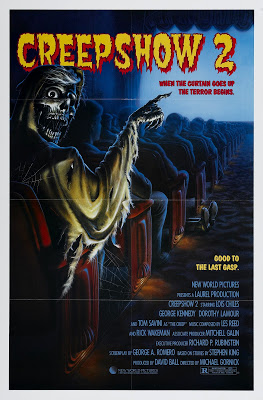

   In my opinion, if the “The Hitch-hiker” episode had been switched out with the “Father’s Day” short from the first … and that horrible epilogue dropped … then 1982’s “Creepshow” would have a secure spot as one of my top ten favorite horror movies. The sequel "Creepshow 2" certainly has value for featuring my favorite short of the bunch, but it just doesn’t excuse the blandness of everything else. For all my issues with the first movie, it still had an original look, feel, personality, and has just held up as the better alternative. 
Over the years, there have been a number of Dark-Comedy horror themed anthologies trying to replicate what “Creepshow” perfected, but none of them have come close. While my feelings toured “Creepshow” are very mixed, it’s still something I enjoy re-watching now and then around the Halloween season. It’s one of those rare horror films that doesn’t aim for serious scares and instead just busts loose for some fun. Actually, it’s like the grownup version of the “Goosebumps” series I grew up with back in the 90’s, as it likewise combines campy frights with creativity and atmosphere. Honestly, I’d give “Creepshow” a slot alongside both “The Shining” and “Misery” as one of my favorite movies adapted from Stephen Kings written work. The special effects are appealing, the direction is stylish, and in the end, this spooky anthology highlights just how fun a horror movie can be.


Thanks for reading my review of the 1982 horror anthology “Creepshow”, along with it's sequel … and treat yourself to one good scare this October. 
                 Happy Halloween!        


Hotel Transylvania (2012) (Movie Review)

 There are Halloween specials that pique my interest before I even watch them, and there's the very special one's that sneak up on me and become a welcome surprise. The 2012 animated film “Hotel Transylvania” is one such movie that didn't interest me with its advertising, but through a series of events, I ended up watching it and found myself won over by a new holiday favorite. Honesty ... I fell in love with this film almost immediately. While I still prefer the scarier and darker style Halloween films aimed for kids in the vein of “ParaNorman” or “Coraline”, but “Hotel Transylvania” rekindled my childhood love and nostalgia for the season better than most did before.


  The premise goes like this … Count Dracula fears that all monsters are in danger from the looming threat of humankind. So, he builds a giant castle resort to keep all the classic monsters, and most importantly his doubter Mavis, safe from the pitch forks of humanity. She in turn has grown restless of her castle prison, wants to make a life for herself, and venture out into the larger world beyond Transylvania. On the eve of her birthday, a human boy discovers Dracula’s monster retreat, and through a series of events ... ends up winning the heart of the count's doubter. Dracula naturally is quiet displeased with his intrusion, but he also can’t deny that for once his doubter seems to be happy. So, he lets the boy stay under the disguise of a Frankenstein type monster named "Johnny-Stein". From there, it’s just a wild series of events with Johnny-Stein bringing modern age entertainment to the monsters, while Dracula just tries to keep peace in his castle. On paper this sounds like a very one-note premise, with lots of recycled ideas from other films, but the creative team behind this movie just put their all into it, resulting in one of the most well realized renditions of a familiar formula.


 I should note that I’ve never really been a fan of Adam Sandler. At worst, his stinkers tarnish what makes a good comedy, and even at his very best ... I could sit down, and have some laughs, but nothing would really stick with me either. 
I bring this up because, in my opinion, “Hotel Transylvania” is my favorite of his movies by a mile ... at least from the ones I've seen. Subsequently, his portrayal of Dracula is great, and honestly one of his best. Not only is Adam Sandler funny, he’s also very charming, and brings an honest sense of passion to the role. I actually have to remind myself that it’s Adam Sandler supplying the voice, because the character just comes to life on his own. Not only is the voice work great, but the performance in the animation is outstanding. Every single expression, whether it be over the top silly, cheerful or sentimental always clicked. It’s hard to describe, but it might just be one of my favorite “animation performances” I’ve ever seen. 
All the other classic movie monsters are present including Frankenstein, The Wolf Man, The Bride of Frankenstein, The Invisible Man, The Mummy, and tons of other popular monster alumni. All of them perfectly recognizable, just with enjoyably cartoonish makeovers, and all voiced by various talents (mostly from SNL), including Kevin James, Steve Buscemi, Ceelo Green, Molly Shannon, and David Spade. One minor nit-pick is that the Creature from the Black Lagoon is reduced to a small background character, which is ridiculous, because he should be a lead along with all the other classics featured in this film. While none of the other monsters are as lovable as the count, they are still very charming, and fun in their own respected ways. I actually found myself enjoying most of the smaller side characters, like this pair of cranky skeletons who are on a romantic retreat, or the Witch maids, the shrunken heads that make sure no-one is disturbed, the suits of armor who make the reports, the pumpkin headed coachman, and the old Gremlin lady who “didn’t do that”. The Wolf Man also has this massive litter of uncontrollable cubs, and has one girl pup among them named Wendy. Despite her small amount of screen time, she is one of the most lovable characters in the films roaster.


  Now, even with all that said, for me personally, the biggest break out character of the film is Dracula’s doubter Mavis, who I think belongs right up there with Jack Skellington as one of the great iconic animated Halloween characters. 
She’s voiced by Selena Gomez, and just like with Adam Sandler, I’ve never really been a fan, but she’s great in the role. Also, just like with Dracula, the performance through the animation is excellent. She conveys all the right emotions, and Mavis herself is just irresistibly cute. I’d go so far to say that she surpasses more than half of the Disney Princesses, both on the cute scale, and for just being an enduring character. This is a girl with a contagiously cheerful personality, but the character is also layered with personal conflicts, as well as subtle drama that make us sympathize with her in just the right amounts. Granted, her back story is nothing original. In fact, it almost feels like a cut and pace of “The Little Mermaid” half the time, especially with the overbearing parent refusing to let her child explore the larger world, and is forbidden to make contact with humans. Regardless, the familiar backstory works in this film, largely because she has absolute perfect chemistry with her father. The relationship between the two mixes charm, zany fun, and subtle touching humanity all in one excellent package. Speaking of family ties, Adam Sandler worked his real-life family into the movie in a couple ways. During the flashbacks, Dracula’s wife Martha is voiced by Sandler’s wife Jackie Sandler, and little girl Mavis is voiced by one of Sandler’s daughters Sadie Sandler.  


 The only character I didn’t care for was the human boy Johnny, who’s silly quirks got kind of old. The hummer associated with all the monsters felt mostly timeless, whereas the hummer from Johnny feels like a dated 90’s product. Andy Samberg is at least committed to the role, and despite his many annoyances, the character himself at least has some redeeming qualities. Obviously, his relationship with Mavis is at the heart of the film, and while I think Mavis is far too good for this guy, they at least share some really good scenes together. I love the moment when Johnny cleverly shows Mavis a beautiful sun rise, which she never had the privilege of seeing before. That image of the sun’s glow reflected in her eyes is such a great visual, and it’s just those little details that really make me love this movie. 


 This movie is also a production of Sony Animation studios, and while I’ve never really loved this particular cartoon studio, I still must confess that the animation on display in “Hotel Transylvania” is right up there with the best of what either Pixar or DreamWorks have delivered. Seriously, everything about the animation in this film just pops on the screen. 
The details are absorbing, the colors are great, and I especially love the depth of field on display, as the characters can really move around in the environment. More than anything, I love the energy in this animation. The timing is amazing, and it’s some of the quickest movement I’ve ever seen in an animated production. One of my favorite scenes is when Dracula and Johnny are setting up tables in a dining room. These tables all have cute ghost face covers, and can fly or move on command. This leads into an especially fun, and cheerful scene where the two go from stressful party planning, to a fun game that allows both Dracula and Johnny to bond. The whole movie flows with this quick and energized pace, but again, there’s still enough time dedicated to the characters and their emotional moments. Count Dracula for example is given a surprisingly tragic backstory that stands as one of the films best emotional highlights. This one final image of Dracula holding his baby, while standing silhouetted against a burning caste is a thing of beauty to say the least. Usually in most movies, these different tones just can’t mesh, but I think this film paces the events so well, that we can transition from cartoony antics to softer character moments without it coming off as jarring.  
 

 Typically in animated Halloween films of this sort, there’s always a big climax with lots of mayhem and monster action, but that’s not the case with “Hotel Transylvania”. The ending is about as simple, yet satisfying as they get, with Dracula finding new faith in humankind, and our young couple get together. There isn’t even a villain that needs to be thwarted, it’s just a series of events with these great characters that reaches perfect finality, and I really respect that approach. The closest we get to a villain is the Hunchback of Notre dame, who’s voiced by John Lovitz, but even he comes off as just a mild nuisance more than anything else. The music in this film is also really good too, although it’s admittedly not the traditional spooky fun music I typically like to hear in Halloween specials. The songs in this film are more colorful and bouncy, but it works within the context of the film. The closing “Zing Song” is an especially upbeat, and catchy tune. There’s a song called “Problem (The Monster Remix)” performed by both Becky Gomez and Will.i.am, which typically isn’t my kind of music, but sense it’s connected with this film, I can’t help but enjoy it on some level, and even have it bouncing in my head after I’ve listened to it. 


  All in all, I think the first “Hotel Transylvania” can easily be regarded as one of the great new Halloween classics. The characters are lovable, the jokes can be very funny, the animation is top notch, the setting alone encompasses a perfect Halloween atmosphere and more than anything, there is a beating heart at the center of this film. 
Unfortunately, I’m not sure if this is a movie for everyone, as the loud and giddy tone might turn some adults away before they give it a chance. Yes, the film gets silly and over the top, but I never felt like it went too far. Personally, I think that the film is much smarter, and much sweeter then it’s cartoony look and attitude suggests. Sure, even the script is very basic, and it doesn’t have the same adult appeal as something like “Coraline”, but this still makes for a great alternative to watch. “Hotel Transylvania” is a terrific reminder that some of my favorite Halloween specials as a kid were more light-hearted and fun. “Hotel Transylvania” has become something that’s only gotten better for me on repeated viewings, and I just can’t imagine an October without viewing it at least once. If you haven’t seen it yet, maybe check it out this Halloween season, and get a pleasant surprise, like I did on my first viewing.


 In the end, I feel the series can finally stop, because there's only so much of a good thing that I can take. I still love the first "Hotel Transylvania", will gladly return to it for many Halloweens to come, and the sequels have been passable one-off experiences. If any of them look good to you, be sure to check them out for yourself.  
  

Thanks for reading my review of the animated 2012 picture “Hotel Transylvania” ... and continue to make every day in October feel like Halloween! 

Monday, October 22, 2012

Psycho (1960) (Movie Review)


  In the beginning, the horror movie genre started off in a very basic way. Most of them revolved around vampires, giant monsters, creepy things going bump in the night, and supernatural haunts that don’t really exist. Then came the 1960 horror classic “Psycho”, which was one of the first to explore something real … the beast that lies within the mind of a killer. 
To call this one of my favorite horror movies of all time is kind of generic, as it’s already regarded as a film legend, and one of the all-time greats whether it be horror or not. This makes it challenging to review, because people either know all about it, or they’re completely in the dark, in which I can’t risk spoiling everything that makes it great. Well, I like a good challenge, and there’s so much I want to say about one of my favorite horror movies. Of course, the film is written and directed by Alfred Hitchcock, who’s often cited as one of the most influential filmmakers of all time. He was a visionary, someone who took real facts, blended them with dark humor, and psychological themes that reflect his own personal fears. Above all, he was a man who took risks, and “Psycho” was arguably his most daring venture. He didn’t have the studio’s full support, the budget was half of what his other films were made on, and he even set rules for the audience attending. There wasn't even much marketing put into the film, and the trailer didn't show a single clip. Actually, the trailer for "Psycho" is about as classic as the movie, as it just features Hitchcock himself walking around the set, and cryptically describing things in detail. Hitchcock was a big admirer of the "Psycho" book series written by Robert Bloch and loosely based the film off of them. The psycho character in this film was inspired by real serial killer Ed Gein, who would later be the inspiration for the character Leather Face from the 1974 classic “The Texas Chainsaw Massacre”.


  As the movie begins, we’re introduced to a woman played by Janet Leigh, who just stole a large sum of money from her work, and now she’s trying to make some distance between herself and town. I’ll never forget watching this movie for the first time as a young teenager, and instantly getting hooked by the ensuing driving montage, in which the camera holds on her face, while voice over conveys what’s going on back home with everyone discovering the robbery. Now, weather these audio conversations are really happening in the moment, or just the woman’s anxiety conjuring things in her mind is left open for the viewer to decide. This is the style in which Hitchcock is presenting his film, and it pulls me in every time. Plus, the accompanying music composed by Bernard Herman is equally captivating. This score is initially introduced to the audience during the very artistic opening credit scene, but it’ll always be immortalized just for this sequence. Speaking personally, this score still has a tendency to sneak into my subconscious whenever I find myself in a tight spot while driving … weather I make a wrong turn, get a little lost, or find myself running late, this score just creeps its way into my head. The film takes a hard-left turn when she decides to stay the night at the Bates Motel, and we meet the owner ... one Norman Bates. Up until this point, we’ve been following Janet Leigh’s character as our star, yet through this encounter, and one iconic shower scene latter … it’s Norman Bates played by Anthony Perkins who suddenly takes center stage. The rest of the movie deals with the aftermath of the encounter, and a group of people trying to pick-up the trail of both the missing money and the missing person. All the while, further twisted secrets and surprises revolving around Norman Bates and his elusive mother begin to unfold.  


  Just like how “Jaws” got people terrified to go swimming in the ocean, “Psycho” made people scared to take a shower. The famous shower scene is often regarded as one of the all-time most disturbing, and frightening moments in the history of cinema. 
It was shocking for its graphic violence, it’s sharp editing, the loud shrieks of violin’s, for being labeled the first slasher film … but the real reason it was so effective was because … no one expected Janet Leigh’s character to get killed. Before 1960, you never kill the lead character off this early in a film, and especially when it’s a big named actress. This is where Hitchcock’s attendance rules come into play, as he wouldn’t allow anyone in the theater if they didn’t arrive on time, as he didn’t want people showing up late wondering where Janet Leigh was. It’s one of the cleverest, yet riskiest moves a director has ever made, and it pays off so well. Speaking personally again for a moment, while the shower scene was shocking for its time … it still wasn’t the moment that had me leaping out of my skin. For me, it was the following scene when the inspector got murdered on the stairs which scared me senseless. It was loud, sudden, unexpected and the first time I can recall an old Black and White movie giving me chills all over.


  Another testimony to Hitchcock’s firm direction was how he’d let scenes play-out, building up the suspense, and dread, before ultimately hitting us with the surprise. There are lengthy scenes that just carry on with no sound or music, which submerses us into these genuinely uncomfortable situations. While I’ve loved movies my whole life, I never really studied the art of film-making until my later teen years, yet I was about 14 when I first saw “Psycho”, and I was absolutely entranced by the technical’s on display. 
Another simple, yet stand-out moment for me is this one little scene in which we see a woman approaching the ominous Bates family House, and half of it is conveyed through a first-person perspective as she approaches the front door. It’s little touches like that which honestly made me feel more uncomfortable then any of the violent killings. To save money (and evade the censorship’s scissors), Hitchcock also filmed this movie in Black and White, even though color was available at the time. It may throw-off common audience's desensitized by the advent of color, but I think that it adds to the whole dark and moody tone of the film. There’s also symbolism and metaphors conveyed through certain objects seen through the picture. You could probably come up with a dozen different meanings behind the room with the stuffed birds … although, I always saw it as clever foreshadowing from the director on what his next horror movie project would be ... a little 60's classic called "The Birds".   


  The best thing about this movie is the character study of our lead antagonist Norman Bates. Without spoiling too much, this is a character that always keeps you guessing, as you can never tell if he’s an innocent victim, or an ingenious mastermind … is there a good man deep inside or is he just a time bomb waiting to go off. All this mystery surrounding the character just builds and builds to a nail-biting climax. I dare not spoil the ending, so I’ll just say that just about every movie with a twist ending owes something to this film, and to Anthony Perkins intense performance as Norman Bates. Something about his screen presence just leaves this permanent impression, and that final shot of him smiling at the camera is still unnerving to this very day. This was also the first branded horror movie to put a new face on its villain. Norman Bates at first glance doesn’t come off as wicked or imposing, instead he’s a handsome young man with both charm and personality on full display. Putting aside the famous shower scene and Hitchcock’s masterful film-making ... it’s the films horrifying suggestion of what goes on behind closed doors that keeps it frightening to this very day. You can meet a regular guy that works behind a desk, yet … he just might me hiding a dark secret that he keeps locked away, and you’d never know. It’s a chilling concept, and after I saw the movie for the first time, it left me with an eerie feeling that someone as messed-up as Norman Bates could be out there in the world right now. 


   In the end, while I’ve never made it a tradition to re-watch “Psycho” around the Halloween season with all my other favorite scary films, it’s still unmistakably one of the all-time greats that the horror genera has to offer, and I’d still rank it among my favorites. It’s solidly constructed, there’s crafty camera angles, a memorable score, untouchable scenes, and at the center of it all is one of cinema’s defining villains. 
After Universals classic monster’s in the vain of “Dracula”, “Frankenstein” and “The Wolfman” left the cinema’s, the horror genera was frequently looked down on as exploit-ave drive-in fodder, and was given little respect. “Psycho” was the mile stone that changed the game, and highlighted just how influential and dignified the genera could be when in capable hands. Surprisingly, the film only got three Oscar nominations. Alfred Hitchcock naturally was nominated for best director, the art direction also received a nomination, and finally Janet Leigh was nominated for best actress in a supporting role … although, I always felt that Anthony Perkins equally deserved a nomination for his portrayal of Norman Bates. On a side note, this was one of my earliest horror movie experiences that got me interested in exploring further films of the genera. I distinctly remember watching it with my sister for the first time, and when it was over, she and I just had chills all over from what we experienced. It further proves that after all these years, “Psycho” is undated, and can still leave an impact on modern viewers. It’s immortal for its contribution to the horror genre, and even if you’re not a fan of scary movies ... I’d still recommend giving the movie a viewing.


Thanks for reading my review of the 1960 Horror classic “Psycho” … and treat yourself to one good scare this October.